
Environmental Impact of Screw Piles vs. Concrete Foundations
As the global drive toward net zero intensifies, energy infrastructure developers are under increasing pressure to select foundation solutions that support environmental targets without compromising performance. For Battery Energy Storage Systems (BESS), where speed, resilience and low-impact installation are critical, the choice of foundation technology can have a significant effect on a project’s total embodied carbon and ecological footprint.

A lower-carbon path to BESS deployment
RADIX screw pile foundations offer a credible, proven alternative to traditional concrete foundations. Compared to concrete, which contributes approximately 8% of global CO₂ emissions, screw piles drastically reduce environmental impact while meeting or exceeding structural performance benchmarks. For renewable energy developers, investors, and EPCs seeking a sustainable and compliant pathway to energisation, screw piles present clear environmental advantages across the lifecycle of a BESS project.

Lower embodied carbon
The manufacture and use of concrete is one of the largest single sources of industrial CO₂ emissions globally. Each tonne of cement releases an estimated 600–900kg of CO₂, and a typical concrete foundation system demands significant volumes of cement, reinforcement steel, and aggregate. When scaled across a multi-MW BESS site, the carbon cost becomes substantial.
RADIX screw piles eliminate the need for concrete in the foundation phase entirely. Manufactured from steel, which itself is recyclable and reusable, screw piles are designed to deliver equivalent or superior load-bearing capacity without wet trades or mass materials use. In comparative project scenarios, this has delivered an embodied carbon reduction in excess of 60%, a figure borne out by recent deployments across the UK, Europe and Australia.
This reduced carbon footprint directly supports Environmental, Social and Governance (ESG) metrics and is increasingly critical in securing planning consent, subsidy eligibility, and investment approval.

No excavation. No spoil. No waste.
Concrete foundations require extensive excavation, formwork, batching and site preparation. These processes generate large volumes of spoil, much of which is sent to landfill. They also necessitate multiple vehicle movements, importing raw materials and exporting waste, increasing site emissions and disruption, especially in rural or constrained areas.
By contrast, RADIX screw piles are installed using small hydraulic rigs with minimal disturbance. There is no excavation, no need for piling mats, and no spoil produced. On sites like Monkfryston and SolarPro’s Budapest installation, this approach reduced groundworks vehicle movements significantly, avoiding heavy lorry traffic and associated emissions.
Because the process is dry and self-contained, there is also no risk of leachate or contamination of nearby watercourses, a significant benefit in flood-prone or environmentally sensitive locations.

Reusability and circularity
A further environmental advantage of screw pile foundations is their reversibility. Once a BESS installation reaches the end of its service life, screw piles can be fully extracted, leaving no sub-surface contamination or demolition debris. This supports circular construction practices and ensures that land can be returned to pre-installation condition or reused for future infrastructure.
In contrast, concrete foundations are typically left in place or require mechanical breaking and disposal, generating both cost and environmental burden at the decommissioning phase.
RADIX screw piles are fabricated from hot-dip galvanised steel to BS EN ISO 1461:2009, ensuring corrosion resistance and long-term structural integrity. When extracted, they can be recycled as scrap steel or redeployed on other suitable projects, further extending their lifecycle value.
Reduced emissions through faster, lighter construction
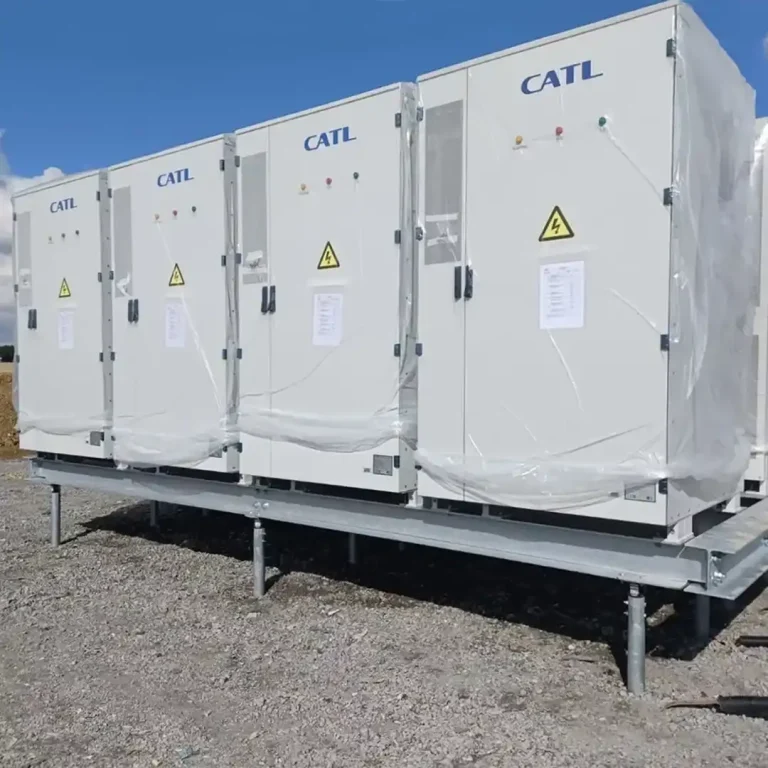
The environmental impact of a construction project is not limited to its materials. Time on site, machinery use, and labour intensity all contribute to the total carbon footprint. RADIX screw piles can be installed at speed, typically reducing programme time by over 50% compared to traditional civils. In the SolarPro project, all foundations and steel supports were installed in just four days, avoiding the multi-week concrete cure times and wet trades coordination required by conventional methods.
Fewer trades, fewer deliveries, and less equipment means lower energy consumption and lower indirect emissions. This also has knock-on sustainability benefits for neighbouring communities, with reduced site disruption, lower noise levels, and fewer HGV movements through local road networks.
Because the installation process is unaffected by weather conditions, delays and their associated costs and emissions are also minimised. Projects can progress reliably and predictably, contributing to greater sustainability and financial performance at the same time.

Supporting net zero, not just greenwash
Environmental performance must be more than a branding exercise. For RADIX, it is embedded into every layer of product engineering, testing, and delivery. The company’s foundation systems are designed from the outset to reduce environmental burden while delivering structural certainty. That means removing concrete, simplifying logistics, designing for disassembly, and verifying sustainability gains through actual site data.
With thousands of BESS foundations installed worldwide, all without concrete, RADIX has shown that it is possible to align large-scale energy infrastructure with meaningful environmental stewardship.
For developers facing ESG disclosure requirements, public scrutiny, or environmental impact assessment (EIA) thresholds, screw piles can tip the scales toward planning approval and stakeholder support. The ecological case is clear, and with RADIX’s in-house design and installation model, it can be realised without compromise on cost, schedule, or performance.

Designed for modern energy infrastructure
Every RADIX installation is backed by site-specific design, empirical testing and full QA traceability, ensuring that environmental benefit does not come at the cost of technical rigour. Static load tests are conducted to EN ISO 22477-1:2018 standards using calibrated instrumentation, never based on perceptible movement or visual checks, to ensure compliance with project specifications and regulatory expectations.
This commitment to professional engineering standards ensures that environmental performance is matched by structural performance, a critical balance for projects tasked with delivering long-term grid resilience in variable ground conditions.
Building better foundations for the planet and the project
Concrete has served its place in construction, but for forward-looking energy infrastructure, its environmental liabilities can no longer be overlooked. With concrete-free screw pile solutions now proven at scale, BESS developers have a viable, lower-carbon alternative that performs to the highest structural standards.
RADIX foundations deliver the speed, strength, and sustainability required to meet the energy transition’s most urgent targets, and do so while materially reducing the environmental impact of construction.
To explore lower-carbon foundation options for your BESS site, speak to the RADIX team today.