
Earth Anchors and Ground Anchor Systems
Engineered Anchoring Solutions for Structural Stability
Earth anchors, often referred to as ground anchors, ground anchor bolts, or ground bolts, are used to restrain structures against uplift, tensile and lateral forces acting below ground level.
Product Supply Enquiry Supply & Installation Enquiry
Not sure of what screws you need? Contact us for help.
In modern engineering practice, these anchoring functions are frequently delivered using helical screw pile foundation systems. These systems provide reliable resistance to uplift, tensile and lateral loads while safely transferring structural forces into stable ground strata.
Although terminology varies across construction sectors, the engineering principle remains the same: a ground anchor must provide predictable load resistance, long-term stability, and verifiable performance under real site conditions.
For infrastructure and energy projects, screw pile foundations provide an efficient way to achieve this anchoring performance while enabling rapid installation and measurable structural verification.
RADIX designs and installs engineered screw pile foundation systems that act as ground anchors where uplift or tensile forces must be resisted, ensuring structural reliability across demanding construction and energy infrastructure environments.
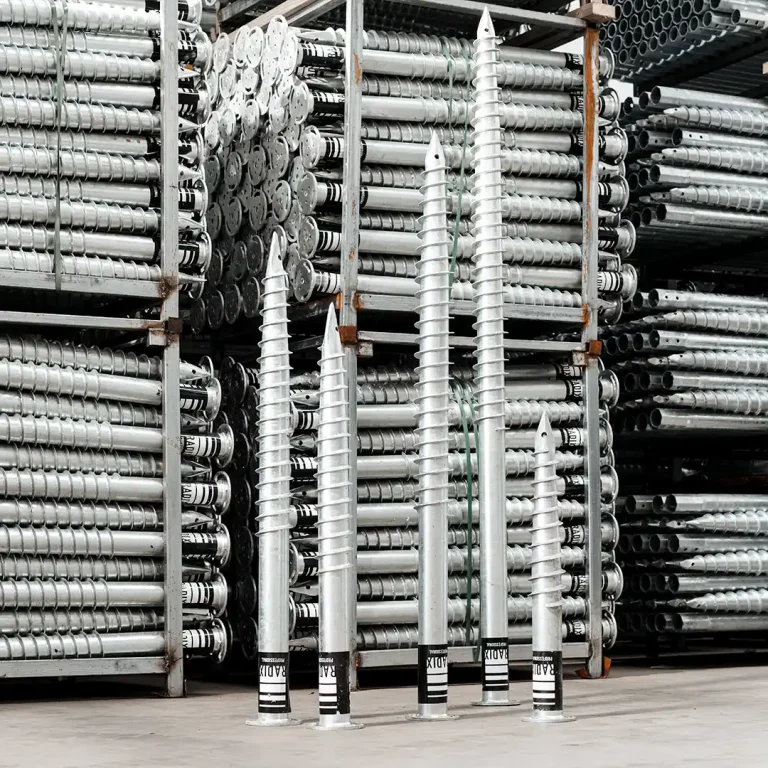
What Are Earth Anchors?
An earth anchor is a structural element installed into the ground to resist forces that could otherwise lift, overturn or move a structure.
Screw-in earth anchors achieve this by using rotational installation. The anchor shaft incorporates one or more helical plates that allow the element to advance into the soil as torque is applied.
As the anchor penetrates the ground, surrounding soil is displaced and compacted around the helices. This interaction enables the anchor to transfer structural loads into deeper, more stable ground layers.
In engineering terms, “ground anchor” describes the structural function, rather than a specific product. In many infrastructure applications this anchoring function is achieved using helical screw piles, which can resist both vertical loads and uplift forces simultaneously.
Because installation relies on controlled rotation rather than excavation or concrete placement, screw anchors can typically be installed quickly while minimising disturbance to the surrounding ground.

Ground Anchors vs Screw Piles
The terms ground anchors, earth anchors, and ground bolts are often used interchangeably, but they describe different structural roles.
Ground bolts generally refer to mechanical fasteners used to connect structural elements to foundations or base plates.
Ground anchors, by contrast, are structural elements embedded below ground level that are specifically designed to resist forces such as uplift, tensile loads, or lateral movement.
A screw pile is a type of engineered foundation system. When designed to resist tensile or uplift forces, screw piles effectively perform the function of a ground anchor while also supporting vertical structural loads.
This distinction becomes important on infrastructure projects where foundations must resist multiple load types simultaneously. In these cases, screw pile systems provide both structural support and anchoring capacity within a single engineered solution.

How Screw Pile Foundations Act as Ground Anchors
Screw pile foundations are installed using hydraulic drive heads mounted on specialist piling equipment.
As the shaft rotates, the helical plates advance through the soil while generating resistance. During installation, torque is recorded continuously. Because torque correlates with soil resistance, this installation data can be used to confirm that the pile is developing the load capacity required by the engineering design.
When acting as ground anchors, screw piles resist tensile forces created by wind loading, structural uplift, or equipment loads. The helices engage the surrounding soil and prevent upward movement while transferring loads into deeper, more stable ground strata.
Where required, static load testing is carried out to verify performance under compression, tension and lateral loading. This provides empirical data on load capacity and displacement behaviour, ensuring the foundation system meets engineering requirements and recognised standards.

Applications for Ground Anchors in Infrastructure
Ground anchor systems are used widely across construction and infrastructure sectors where structures must resist uplift or lateral forces.
Typical applications include:
- Renewable energy infrastructure
- Equipment foundations
- Temporary access structures
- Utility installations
- Structural stabilisation works
In many of these projects, the anchoring function is delivered using screw pile foundations that provide both compression support and uplift resistance.
Because screw pile systems can be installed rapidly with minimal excavation, they are particularly well suited to projects where programme speed, environmental impact, and restricted site access are key considerations.

Ground Anchors for Battery Energy Storage Systems (BESS)
The rapid expansion of renewable energy infrastructure has significantly increased demand for foundation systems capable of supporting heavy electrical equipment while maintaining strict construction timelines.
Battery Energy Storage System (BESS) installations commonly include:
- Containerised battery units
- Power Conversion Systems (PCS)
- Medium-voltage skids
- Associated electrical infrastructure
These installations require foundations that can support substantial static loads while also resisting environmental forces such as wind uplift.
Screw pile foundations allow these loads to be transferred safely into stable ground strata without the extensive excavation associated with traditional concrete foundations.
RADIX screw pile systems have supported energy infrastructure projects worldwide, providing engineered foundations capable of supporting battery containers, PCS units and MV equipment while maintaining strict project schedules.

Load Testing and Verification of Ground Anchors
For modern infrastructure projects, the performance of ground anchors must be validated using measurable engineering data.
Static load testing provides empirical evidence that installed foundations can safely resist design loads. Controlled loads are applied to the pile while displacement is measured using calibrated instrumentation.
The results are analysed to confirm:
- Load capacity
- Settlement behaviour
- Structural safety factors
These findings form part of the engineering documentation required for project approval and regulatory compliance.
By validating performance using real site data, engineers can ensure that screw pile anchor systems deliver the reliability required for long-term infrastructure assets.
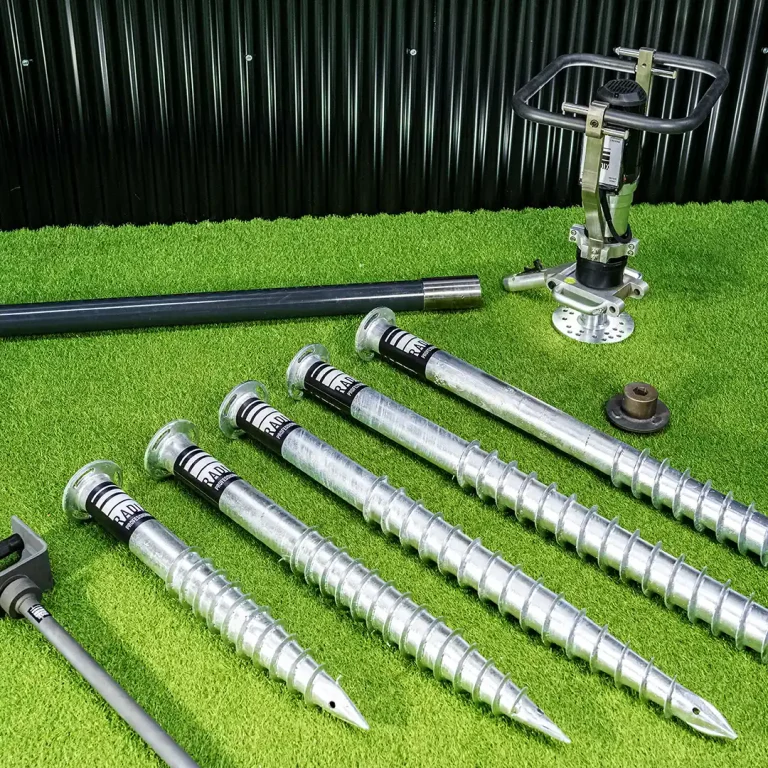
Engineered Screw Pile Foundations from RADIX
RADIX delivers screw pile foundation systems through a comprehensive engineering process that includes consultation, testing, design and installation.
The process typically begins with a review of project requirements and site investigation data. Where necessary, RADIX conducts pre-construction load testing to establish ground performance and confirm suitable pile configurations.
Using this information, engineers develop a foundation design specifying the pile type, depth and configuration required to meet structural loads.
Installation is then carried out using RADIX hydraulic piling equipment, with torque, depth and alignment recorded throughout the process.
Upon completion, full quality documentation is issued including:
- Pile installation logs
- Load test records
- Permit-to-load certification
By combining engineering design, testing and installation within a single process, RADIX ensures that screw pile systems performing ground anchoring functions are installed with full technical accountability.
A Modern Approach to Ground Anchoring
As infrastructure projects demand faster construction, improved sustainability, and greater engineering certainty, foundation technologies continue to evolve.
Screw pile systems represent a modern approach to ground anchoring, combining rapid installation with reliable structural performance.
Their ability to transfer loads safely into deeper strata while minimising ground disturbance makes them well suited to modern construction, renewable energy infrastructure, and equipment foundations.
For projects where structural stability and programme efficiency are critical, engineered screw pile foundations provide a dependable solution — from the ground up.